

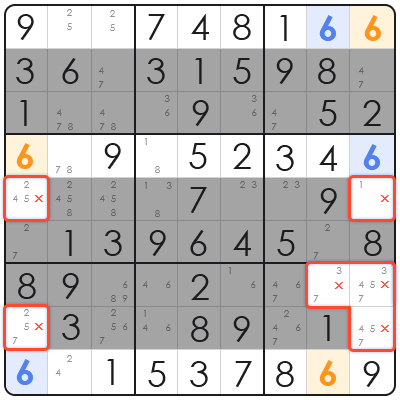

java sudoku array
### Java Sudoku Array Implementation
#### Overview
This article provides a comprehensive guide on implementing a Sudoku solver using a Java array. Sudoku is a popular puzzle game that requires players to fill a 9×9 grid with numbers so that each column, each row, and each of the nine 3×3 subgrids that compose the grid contain all of the digits from 1 to 9. The Java array is an ideal data structure for this purpose due to its simplicity and efficiency.
#### Java Sudoku Array Structure
1. **Array Initialization**
– Initialize a 2D array of size 9×9 to represent the Sudoku grid.
– Each element in the array can hold a value from 0 to 9, where 0 represents an empty cell.
2. **Filling the Array**
– Populate the array with the given values from the Sudoku puzzle.
– Ensure that the values do not violate the Sudoku rules.
3. **Validation and Solution**
– Implement a method to validate whether a given number can be placed in a specific cell without violating Sudoku rules.
– Use backtracking to solve the Sudoku puzzle by trying different numbers in empty cells and backtracking when a conflict arises.
#### Code Example
“`java
public class SudokuSolver {
private static final int SIZE = 9;
private int[][] board;
public SudokuSolver() {
board = new int[SIZE][SIZE];
}
public void solveSudoku() {
if (solve()) {
printBoard();
} else {
System.out.println(“No solution exists.”);
}
}
private boolean solve() {
for (int row = 0; row < SIZE; row++) {
for (int col = 0; col < SIZE; col++) {
if (board[row][col] == 0) {
for (int num = 1; num <= SIZE; num++) {
if (isValid(row, col, num)) {
board[row][col] = num;
if (solve()) {
return true;
} else {
board[row][col] = 0;
}
}
}
return false;
}
}
}
return true;
}
private boolean isValid(int row, int col, int num) {
return !usedInRow(row, num) && !usedInCol(col, num) && !usedInBox(row - row % 3, col - col % 3, num);
}
private boolean usedInRow(int row, int num) {
for (int i = 0; i < SIZE; i++) {
if (board[row][i] == num) {
return true;
}
}
return false;
}
private boolean usedInCol(int col, int num) {
for (int i = 0; i < SIZE; i++) {
if (board[i][col] == num) {
return true;
}
}
return false;
}
private boolean usedInBox(int boxStartRow, int boxStartCol, int num) {
for (int i = 0; i < 3; i++) {
for (int j = 0; j < 3; j++) {
if (board[boxStartRow + i][boxStartCol + j] == num) {
return true;
}
}
}
return false;
}
private void printBoard() {
for (int i = 0; i < SIZE; i++) {
for (int j = 0; j < SIZE; j++) {
System.out.print(board[i][j] + " ");
}
System.out.println();
}
}
}
```
#### FAQ
**Q: What is a Sudoku array?**
A: A Sudoku array is a 2D array used to represent the Sudoku grid. Each cell in the array can hold a number from 1 to 9, or 0 to represent an empty cell.
**Q: How do you initialize a Sudoku array?**
A: Initialize a 2D array with the desired size (9x9 for standard Sudoku) and set all elements to 0 to represent empty cells.
**Q: What are the main components of a Sudoku solver using an array?**
A: The main components include initializing the array with given values, implementing a validation method to check for conflicts, and using backtracking to solve the puzzle.
**Q: Can a Sudoku puzzle be solved using a single row or column?**
A: No, a Sudoku puzzle requires filling the entire 9x9 grid. Each row, column, and 3x3 subgrid must contain all digits from 1 to 9 without repetition.
**Q: How does backtracking help in solving Sudoku?**
A: Backtracking is a recursive algorithm that tries different values in empty cells and backtracks when a conflict arises. It ensures that all possible solutions are explored until the puzzle is solved or determined to be unsolvable.