

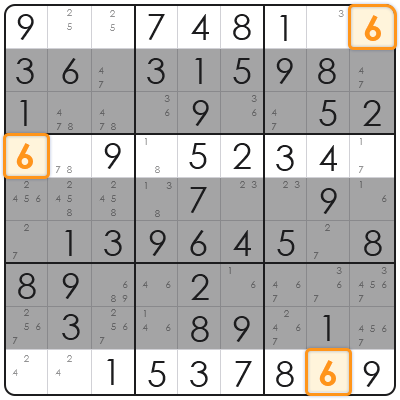


five sudoku with their explanation
### Five Sudoku Variations Explained
#### Sudoku: A Quick Overview
Sudoku is a popular logic-based combinatorial number-placement puzzle. It was invented in 1979 by Howard Garns of the USA. The objective of the puzzle is to fill a 9×9 grid with digits so that each column, each row, and each of the nine 3×3 subgrids that compose the grid contain all of the digits from 1 to 9. The puzzle setter provides a partially completed grid, which for a well-posed puzzle has a single solution.
#### Sudoku Variation 1: Standard Sudoku
Standard Sudoku, often just referred to as Sudoku, follows the rules mentioned above. It is a 9×9 grid, and players must place numbers from 1 to 9 into the grid such that each row, column, and 3×3 subgrid contains all of the digits 1-9. It is a single-player game, and players typically work through puzzles without any assistance from technology.
#### Sudoku Variation 2: Diagonal Sudoku
Diagonal Sudoku is a variation where the objective is not only to have each row, column, and 3×3 subgrid contain the digits 1-9, but also for each of the two main diagonals to contain all the digits as well. This adds an extra layer of complexity and requires players to be mindful of both the horizontal and vertical rows, as well as the two diagonals.
#### Sudoku Variation 3: Mini Sudoku
Mini Sudoku is a smaller version of the traditional puzzle, with a grid size of 6×6 instead of the standard 9×9. The same rules apply, with the aim being to fill in the 6×6 grid with digits 1-6. The smaller grid size means that solutions can be found more quickly and is suitable for players of all ages and skill levels.
#### Sudoku Variation 4: Sudoku X
Sudoku X is another variation where the diagonals also play a key role. In Sudoku X, players are required to place the digits 1 to 9 in a 9×9 grid in such a way that each row, column, and the two diagonals contain all of the digits 1-9. The “X” refers to the diagonal pattern created by these constraints, hence the name Sudoku X.
#### Sudoku Variation 5: Jigsaw Sudoku
Jigsaw Sudoku is a variation where the standard 9×9 grid is replaced by a non-standard shape with 9 cells. This shape can be split into 9 subgrids, each of which must contain the digits 1-9. In addition to the traditional Sudoku rules, players must also consider the shape of the grid when placing numbers, which adds a unique challenge to the puzzle.
### Frequently Asked Questions (FAQ)
**Q1: Can I play Sudoku on a smartphone or computer?**
A1: Yes, Sudoku can be played on smartphones, computers, and tablet devices. There are numerous mobile apps and online platforms where you can download Sudoku games or play them directly in a web browser.
**Q2: Are there any strategies to solve Sudoku puzzles faster?**
A2: Yes, there are several strategies you can use to solve Sudoku puzzles more quickly. Some popular techniques include using only logic (no guesswork), identifying and marking possible numbers for each cell, and solving subgrids one at a time.
**Q3: What is the hardest level of Sudoku?**
A3: The difficulty level of Sudoku puzzles can vary greatly, from easy to very hard. Some of the most challenging puzzles are considered to be “fiendish” or “extreme.” These puzzles often require advanced techniques and a great deal of patience and skill to solve.
**Q4: Can Sudoku be solved blindfolded?**
A4: Yes, it is possible to solve Sudoku blindfolded, although it is an extremely challenging feat. Blindfolded Sudoku requires advanced techniques and a lot of practice. Most people cannot solve it without visual clues.
**Q5: Are there any benefits to solving Sudoku puzzles?**
A5: Yes, solving Sudoku puzzles has several benefits. It can improve cognitive functions such as memory, attention to detail, and problem-solving skills. Sudoku can also be a fun and relaxing activity for people of all ages.