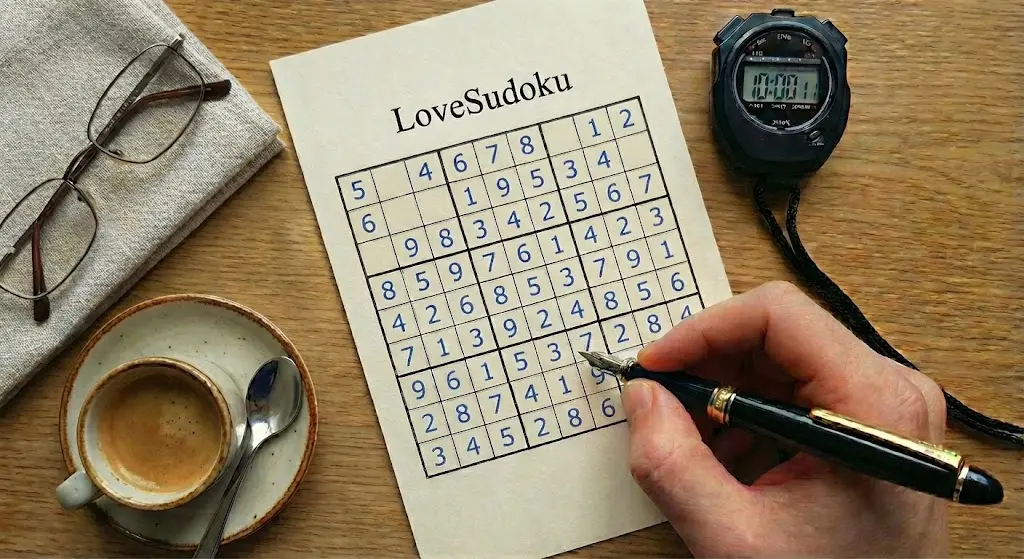

how to do sudoku puzzles
# How to Do Sudoku Puzzles: A Step-by-Step Guide
Ah, Sudoku puzzles! They’re those little grid-based conundrums that seem to crop up in newspapers, magazines, and online. They’re a great way to keep your brain in tip-top shape and pass the time. Whether you’re a Sudoku beginner or a seasoned solver, there’s always something new to learn. Here’s a step-by-step guide to help you master the art of Sudoku puzzle-solving.
## Step 1: Understand the Basics
First things first, let’s get the basics down pat. Sudoku is a logic-based, combinatorial number-placement puzzle. The objective is to fill a 9×9 grid with digits so that each column, each row, and each of the nine 3×3 subgrids that compose the grid contain all of the digits from 1 to 9. Sounds tricky, doesn’t it? It’s not as hard as it seems once you get the hang of it.
## Step 2: Start with the Easy Ones
When you’re first starting out, it’s a good idea to work on easier puzzles. These typically have fewer numbers already filled in, making it easier to deduce where the next numbers should go. As you become more comfortable, you can move on to harder puzzles that require more advanced techniques.
## Step 3: Look for Patterns
One of the most effective Sudoku-solving techniques is pattern recognition. Take a look at the rows, columns, and 3×3 subgrids. You’ll often notice that certain numbers are missing or repeated in certain patterns. For example, if a particular number is missing in a row, it’s likely to appear in one of the other rows in the same column.
## Step 4: Use the Process of Elimination
If you can’t determine where a number should go, use the process of elimination. Look at each cell in the grid and eliminate any numbers that cannot possibly fit based on the current state of the puzzle. This will often lead you to the correct number for the cell.
## Step 5: Check for Contradictions
If you’re entering a number into a cell and it creates a contradiction (i.e., the same number is already in the same row, column, or 3×3 subgrid), you know that the number is incorrect. Backtrack and try a different number.
## Step 6: Practice Regularly
Like any skill, Sudoku-solving gets better with practice. Try to solve at least one puzzle a day to keep your skills sharp.
## Frequently Asked Questions (FAQ)
### Q: Do I need to be good at math to solve Sudoku puzzles?
A: No, Sudoku puzzles are all about logic and pattern recognition. You don’t need any mathematical knowledge to solve them.
### Q: How can I improve my Sudoku-solving skills?
A: Practice is key. Try to solve a variety of puzzles, and don’t be afraid to tackle harder ones as you get more comfortable. You can also read books or online articles about advanced Sudoku-solving techniques.
### Q: What’s the best way to approach a new Sudoku puzzle?
A: Start by filling in any obvious numbers, then look for patterns in rows, columns, and subgrids. Use the process of elimination to narrow down possibilities, and always check for contradictions.
### Q: Are there different types of Sudoku puzzles?
A: Yes, there are many different types of Sudoku puzzles, including standard Sudoku, Killer Sudoku, Samurai Sudoku, and more. Each type has its own unique rules and challenges.
### Q: Is there a limit to how many Sudoku puzzles I can solve?
A: No, there’s no limit to how many Sudoku puzzles you can solve. In fact, the more you solve, the better you’ll become at them. Just make sure to take breaks to prevent burnout!
And there you have it! With these tips and techniques, you’re well on your way to becoming a Sudoku master. Happy solving!